
The decoder runs in your browser. If nothing happens when you press Agree & decode, check that JavaScript is on, or ask me and I'll read it for you.
Fret Almanac
Epiphone serial number lookup
Most Epiphones you'll come across carry one of two formats, on the back of the headstock or on the label inside. From about 1993 to 2010 it's one or two factory letters, the year, the month and a running number. Since about 2008 it's all digits: the first two are the year, the next two the month, then two for the factory and a running number. Gibson documents both. Older Epiphones, from the New York years, the Kalamazoo years and the Japanese era, rest on collectors' charts, so the decoder grades them lower and says why.
Guitars I have for sale
Epiphone guitars in stock now
Every one is picked, played and dialed in by me before it's listed.
-
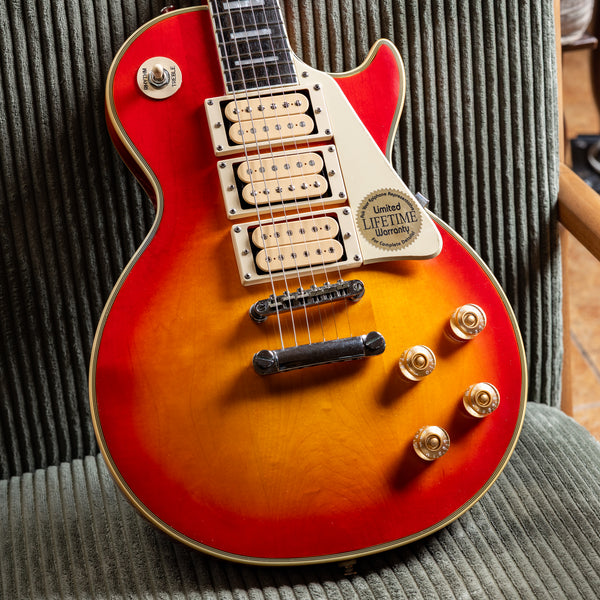 Very Good
Epiphone Ace Frehley Signature "Budokan" Les Paul Custom 2012
Faded Cherry Sunburst
Direct price $2,085My Reverb listing $2,195
-
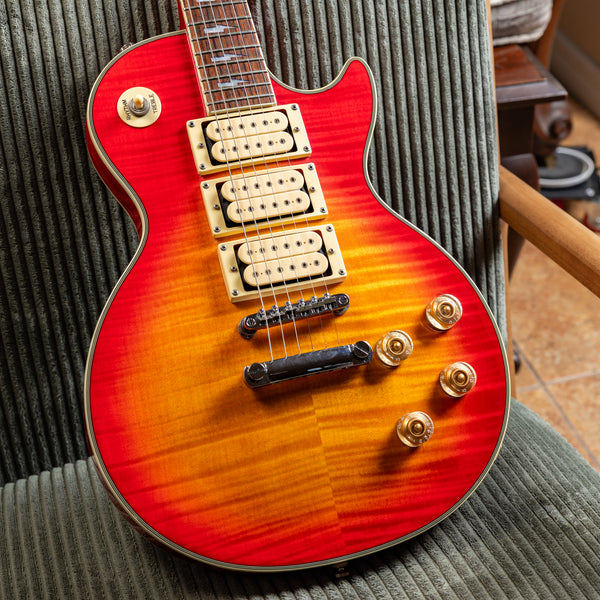 Very Good
Epiphone Ace Frehley Signature Les Paul 2000
Heritage Cherry Sunburst
Direct price $1,560My Reverb listing $1,645
-
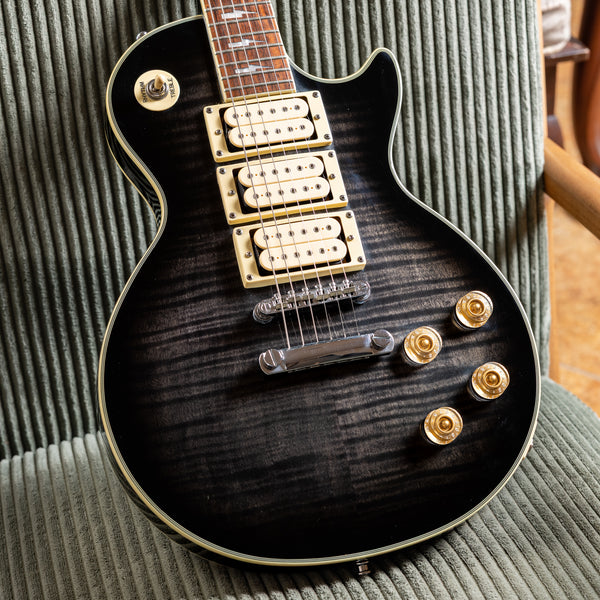 Very Good
Epiphone Ace Frehley Signature Les Paul 2001
Trans Blackburst
Direct price $1,705My Reverb listing $1,795
Selling?
Thinking of letting it go?
I buy Epiphone guitars. Tell me about yours and I'll make you a cash offer.
Get a cash offerI buy guitars as well as sell them. A decoder result is only an estimate, and it's never the basis of my offer. I judge the guitar itself: what it is, its condition and originality, and today's market.
Ask me
Not sure what you've got?
Tell me what you're looking at, and I'll help you read it.
Ask meWhere to find the serial
- The back of the headstock. Most Epiphones since the 1990s.
- The label inside the body. Hollow bodies, semi-hollows and acoustics, read through the f-hole or the soundhole. Hollow bodies built in Kalamazoo from 1958 to 1961 have an A number there.
- Pressed into the back of the headstock. Epiphones built by Gibson in Kalamazoo from 1961 to 1970, with Gibson's own numbers.
- A gold sticker. A number starting with 311 on a gold sticker marks a guitar refurbished by MIRC. It isn't a build date.
Epiphone's numbering, era by era
| Format | In use | Where to look | How sure |
|---|---|---|---|
| New York label number, 1931–1957New York-era Epiphone acoustics and hollow-bodies: a running number on the label or inside the body, dated by the first known number of each year. | 1931 to 1957 | Label inside the body, seen through the soundhole or f-hole; Stamped on the wood inside the body | Low |
| New York electric number, 1935–1956New York-era Epiphone electrics: a number stamped on the headstock (dated by chart to 1935–42, or naming the model on later ones), or on the bridge unit of 1950s Hawaiians. | 1935 to 1956 | Back of the headstock; Bridge plate | Low |
| Kalamazoo hollow-body label number, 1958–1961Hollow-body Epiphones from 1958 to 1961: A plus four digits on the label inside, with each thousand a year (A1000s 1958 to A4000s 1961). | 1958 to 1961 | Label inside the body, seen through the soundhole or f-hole | Low |
| Kalamazoo solid-body ink number, 1958–1960Solid-body Epiphones such as the Crestwood and Coronet, 1958 to 1960: an ink-stamped number whose first digit is the last digit of the year. | 1958 to 1960 | Back of the headstock | Low |
| Kalamazoo impressed number, 1961–1970Epiphones built in Kalamazoo from 1961 to 1970 carry Gibson's own serial numbers, pressed into the back of the headstock, so they're read with Gibson's table. | 1961 to 1970 | Back of the headstock | Medium |
| Japan 1970–1987 or Taiwan, no date codeJapanese-made Epiphones from about 1970 to 1987, and Taiwanese ones from about 1979–80, have no reliable serial system. The label dates them instead. | 1970 to 1987 | Label inside the body, seen through the soundhole or f-hole; Back of the headstock | Low |
| Korean seven-digit date codeKorean-made Epiphones from about 1984 to 1995 with no factory letter: the last digit of the year, the month, then a running number. | 1984 to 1995 | Back of the headstock; Label inside the body, seen through the soundhole or f-hole | Medium |
| Japanese domestic model, 1987–1997Semi-acoustics Terada made for Epiphone's Japanese distributor, Yamano Gakki: the last digit of the year, a model code, then a three-digit number. | 1987 to 1997 | Label inside the body, seen through the soundhole or f-hole | Low |
| Refurbished-unit stickerA gold sticker numbered 311 followed by four digits marks a guitar refurbished by MIRC. It carries no build date, and the years these stickers were used aren't documented. | 1990 to today | Back of the headstock | Low |
| Factory letter with a month letterSome Epiphones from the same years: factory letter(s), a two-digit year, the month as a letter (A for January to L for December), then a running number. | 1993 to 2010 | Back of the headstock; Label inside the body, seen through the soundhole or f-hole | High |
| Factory letter, year and monthMost Epiphones from about 1993 to 2010: one or two factory letters, the year (two digits, or one on some 1990s models), the month, then a running number. | 1993 to 2010 | Back of the headstock; Label inside the body, seen through the soundhole or f-hole | High |
| Japanese domestic model, from 1998Japanese domestic Epiphones from 1998: J or T for Terada, F or no letter for FujiGen, then the last digit of the year, the month and a three-digit number. | 1998 to 2008 | Back of the headstock; Label inside the body, seen through the soundhole or f-hole | Low |
| Elite and Elitist serialJapanese-made Elite and Elitist models from 2002: F for FujiGen or T for Terada, the year (one digit to 2009, two from 2010), then a four-digit sequence. | 2002 to 2018 | Back of the headstock; Label inside the body, seen through the soundhole or f-hole | High |
| All-digit date codeEpiphones since about 2008: a two-digit year, the month, two factory digits, then a four- or five-digit running number. | 2008 to today | Back of the headstock; Label inside the body, seen through the soundhole or f-hole | High |
| Chinese F-series numberChinese-made Les Paul Standard '59 and '60, Tribute and Tribute Plus models from late 2009: F and a running number from F300000, placed in time by known points (up to about 2015) rather than a date code. | 2009 to 2015 | Back of the headstock | Low |
What trips people up
- The factory letters come from collectors. Gibson publishes the layout of the modern serials but not what each factory letter means, so the factory comes from collectors' lists, and a few letters have more than one claimed meaning.
- One digit, two decades. Korean seven-digit numbers from about 1984 to 1995 give only the last digit of the year, so a 4 or a 5 could be the 1980s or the 1990s.
- Japan, 1970 to 1987. Epiphones made in Japan in those years have no reliable serial system, so the label dates them instead: blue to about 1975, the tan or white Lincolnwood label to 1979, then brown.
- Kalamazoo numbers repeat. Epiphones built in Kalamazoo from 1961 to 1970 use Gibson's numbers, and Gibson reused those across the decade, so one number can fit several years.
- A serial never proves a guitar is genuine. Counterfeiters copy real numbers, so the hardware, the label and the finish have to agree with what the serial says.
Questions people ask
Can the serial tell me the model?
Usually not. Most Epiphone serials name only a factory and a date.
What changes on an Elitist?
Elite and Elitist guitars were made in Japan from 2002 and have numbers of their own: F for FujiGen or T for Terada, the year, then a four-digit sequence. If the headstock, the truss rod cover or the label says Elitist or Elite, tell the decoder, because some of these numbers look like other formats.
My Epiphone was built in the USA. Why doesn't it decode?
Epiphones built in the USA outside the Kalamazoo years aren't covered yet, because I haven't found a source I can rely on for their numbering. Tell me about yours and I'll look at the guitar's other clues.
Where this comes from
- Gibson Brands: Epiphone (the maker's own page, read 2026-11-24)
- Gibson Brands: Epiphone Made in USA Collection (the maker's own page, read 2026-11-24)
- Gibson Brands: Gibson Serial Numbers: How to Read Gibson Serial Numbers (the maker's own page, read 2026-11-24)
- Epiphone Wiki: Epiphone Serial Number Decoding (collectors' knowledge, read 2026-11-24)
- Gibson forum (members' guide): ID your Epiphone here: serial key, factory codes, a worldwide guide (part 3) (collectors' knowledge, read 2026-11-24)
- Kramer Forum (members' thread): Kramer Forum thread on Gibson-era serial numbers (t=8389) (collectors' knowledge, read 2026-11-24)
- Gibson forum (members' thread): Let's talk factories (collectors' knowledge, read 2026-11-24)
- New York Epiphone registry: NY Epi Reg: research (collectors' knowledge, read 2026-11-24)
- Gibson Brands, via the Internet Archive: Serial Number Search (archived copy, 20 July 2012) (an archived copy of the maker's page, read 2026-11-24)
- Vintage Guitars Info (a private collector's guide): Vintage Epiphone Guitars: General Information and Specs (collectors' knowledge, read 2026-11-25)
Last reviewed on November 25, 2026 by Shan, Aeonic Frets. If a serial reads wrong, tell me and I'll check it against the guitar's other clues.